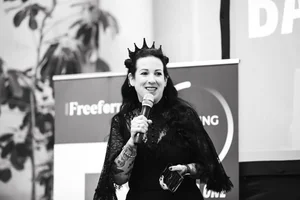
Why other people's perception of HR is your problem to solve
It took me far too long to realise how other people's perceptions of HR would have such a significant effect on my ability to make a strategic impact in my organisation.
Have you ever had someone ask why you were present in a meeting? Or say they didn't invite you because they didn't think it was relevant to HR, or didn't think you'd be interested? I have — including once a rather rude "Why's SHE here?"
I was once asked in a job interview, when I spoke about wanting to understand the roles and priorities of each team, why on earth I would need to know that or need to meet any of that manager's team. He was genuinely surprised that I felt it was necessary.
For some years I assumed this meant I was doing something wrong, or that I just wasn't convincing people of my worth. I realise now it had absolutely nothing to do with me. If I'm honest, even once I understood that, it still wore me down sometimes.
There's a particular kind of exhaustion that comes from walking into rooms where you have to re-establish your right to be there before you've even opened your mouth. It's not a big deal in isolation, but over time it is tiring — and I think it does affect how ambitious HR professionals allow themselves to be. If you've been told often enough, in subtle and not so subtle ways, that you're not quite the right person for this conversation, at some point you start to believe it a little. Recognising that for what it is — a perception problem, not a you problem — is actually one of the more important shifts you can make.
Where these perceptions come from
Everyone has a perception of HR, and unless they've worked in the field themselves, most of those opinions can only have been formed from their own experiences of HR teams and professionals in the organisations they and their family members have worked in.
There is a lot of dislike for HR as a profession out in the world — you only have to look at some of the comments people post on social media to be aware of this. The majority of people who hold these opinions tend to have experienced some disadvantage or negativity in their workplace and believe HR were responsible for it. Whether they got let go from a role or didn't get what they wanted from an organisation, it will nearly always be HR who get the blame rather than the line manager involved.
Sometimes we get scapegoated by managers who hide behind us for their own decisions because they don't want to be disliked or want to avoid awkwardness. We often have to communicate business decisions to the organisation as a whole, and people therefore assume we made those decisions. I can remember having to stand up and tell 500 people that we were moving from a defined benefit to a defined contribution pension plan, and everyone assumed it was something I had decided myself.
These are obviously extreme examples, and the misconceptions don't have to involve outright dislike to have an impact on our ability to do our roles properly. If someone has only ever experienced a reactive, administrative HR department, they are going to see HR as an admin function. It's easy to forget that outside the HR profession itself, most people haven't studied HR and neither know nor care what a Business Partner is, or the Ulrich model, or anything else we've learned about. They only know what they have seen in practice.
We changed, but we didn't bring anyone with us
Being perfectly honest, HR — back when it was called Personnel, and Welfare before that — was an admin function. Our role was almost entirely people operations, employee relations, policy and process.
The profession essentially rebranded itself and redefined its purpose, but it did that largely internally — through qualifications, professional bodies, conferences and frameworks that the rest of the business world wasn't part of and mostly wasn't paying attention to. So while HR professionals were learning about strategic partnership and business impact, the people they were supposed to be partnering with were still working off an entirely different version of what HR was for. We changed, but we didn't necessarily bring anyone with us.
The result is a generation of HR professionals who have grown up expecting to make a strategic impact, but are working alongside people who still see them as the admin function they always were. Is it any wonder that so many people don't know what we do, what we can do, or what we should be doing?
What you can actually do about it
There is probably never going to be a world where everyone is clear on the role of HR. All we can do as individuals and HR teams is work within the areas of influence we have to change those perceptions one person at a time — through our words, actions and behaviours.
You can't change someone's perception unless you know what their current perception is. That's your starting point. Find out what they think you're there for, what they believe your responsibilities are and how they think you add value. I don't mean a formal survey or a structured stakeholder interview, although those have their place. I mean actually asking — having the conversation directly. Something like: "I want to make sure what I'm focusing on is genuinely useful to you, so it would really help me to understand how you currently see HR's role in the business."
Most people will tell you, often more honestly than you'd expect, because nobody ever asks. That conversation alone tends to shift something, because the fact that you're asking at all signals that you're thinking about it differently.
Once you understand how they see you today, you can start working on how they'll see you in the future.